
With the Thar, M&M has come full circle. In a market where every other vehicle has an SUV tag, the company plans to stick to its core competence of making rugged, true-blue, all-terrain SUVs, and marks a fresh beginning for the 75-year-old firm that enjoyed an indomitable position in the SUV segment till 2012, reports Shally Seth Mohile.

Worries related to the Iran-Israel conflict, quarterly earnings and foreign investors' trading activity are the key factors that would dictate stock markets this week, analysts said. Besides, trends in Brent crude oil and movement of the rupee against the dollar will also be crucial factors. This week will be crucial for the market amid ongoing worries about the conflict between Iran and Israel, said Pravesh Gour, Senior Technical Analyst, Swastika Investmart Ltd.

From the Sensex pack, ITC, Titan, Asian Paints, Reliance, Tata Steel, Bajaj Finserv, Axis Bank, Hindustan Unilever, Infosys, Bajaj Finance, Nestle and ICICI Bank were the major gainers. Kotak Mahindra Bank, Mahindra & Mahindra, HCL Technologies, State Bank of India, Bharti Airtel and Tata Motors were among the laggards.

After taking over scam-hit Satyam, Techn Mahindra has made many structural changes in the latter to turn it around.

From the Sensex basket, Tata Consultancy Services, Nestle, Bajaj Finserv, Wipro, Maruti Suzuki India, Reliance Industries, Larsen & Toubro and NTPC were the major laggards. Tata Steel, Bajaj Finance, JSW Steel and Bharti Airtel were among the gainers.

Benchmark equity indices Sensex and Nifty closed higher on Friday after two days of fall, helped by buying in metal, telecom and auto stocks amid a firm trend in global markets. Automakers led by Maruti Suzuki India, Hyundai, Mahindra & Mahindra reporting robust wholesales of passenger vehicles and GST collections crossing Rs 1.50 lakh crore for the third straight month in May also added to the optimism. The 30-share BSE Sensex climbed 118.57 points or 0.19 per cent to settle at 62,547.11.

Investors' wealth eroded by Rs 7.59 lakh crore on Monday as the equity market took a heavy drubbing amid escalating tensions in the Middle East. The 30-share BSE Sensex plunged 825.74 points or 1.26 per cent to settle at 64,571.88 points. During the day, the index plummeted 894.94 points or 1.36 per cent to 64,502.68 points.

The recent blip in housing sales on a quarter-on-quarter (Q-o-Q) basis should not worry investors as the long-term prospects of real estate stocks remain on a strong foundation, according to analysts. In the first half of the calendar year 2024 (H1CY24), realty stocks surged up to 104 per cent. This sharp run should be used to book partial profit in related stocks, suggested Deepak Jasani, head of retail research at HDFC Securities.

Benchmark indices ended in the green on Tuesday after retail inflation dipped below the RBI's upper tolerance level of 6 per cent for the first time in 11 months in November. The 30-share BSE Sensex climbed 402.73 points or 0.65 per cent to settle at 62,533.30. During the day, it jumped 437.35 points or 0.70 per cent to 62,567.92. The broader NSE Nifty advanced 110.85 points or 0.60 per cent to end at 18,608.

Bajaj Finserv was the biggest gainer in the Sensex pack, rising 2.21 per cent, followed by Titan, ITC, Kotak Mahindra Bank, HDFC Bank, HDFC, Bajaj Finance, IndusInd Bank, ICICI Bank, HUL, Reliance Industries and Mahindra & Mahindra. Wipro, Tata Consultancy Services, Power Grid and Tech Mahindra were the laggards.


Passenger vehicle wholesales in India rose to a record high in October as companies pushed dispatches to dealers to cater to the enhanced demand in the festive season. The overall passenger vehicle wholesales in October rose to 391,472 units, up 16 per cent from 336,679 units in the same month last year. Last month witnessed the highest-ever dispatches of passenger vehicles in the domestic market by Maruti Suzuki India and Mahindra & Mahindra.
Kotak Mahindra Bank on Thursday said it planned to expand its network to about 75 branches in three years.
Titan, IndusInd Bank, Axis Bank, State Bank of India, Power Grid, NTPC and Tata Motors were among the among the major gainers. Mahindra & Mahindra, Larsen & Toubro, Nestle, JSW Steel, Infosys and Tata Consultancy Services, Tech Mahindra and Maruti were the major laggards.
Mukesh Ambani-controlled Reliance Retail is planning a second-hand car market venture on the lines of Maruti's True Value and Mahindra's Automart.

Maruti Suzuki India and Hyundai reported single-digit sales growth in July with the sports utility segment continuing to drive overall demand in the market. Mahindra & Mahindra witnessed a 29 per cent increase in passenger vehicle dispatches while Tata Motors saw a marginal increase in the wholesales last month. Maruti Suzuki on Tuesday said its total domestic passenger vehicle sales stood at 152,126 units last month as compared to 142,850 units in the year-ago month, a growth of 6 per cent.
The $6.3-billion Mahindra Group expects to grow revenues from its agri-business venture nearly eight-fold in the next five years by expanding among national and overseas retail chains, a top group official said.

This is the case even though the benchmark index is only 5 per cent below its all-time high. The list of stocks trading at a discount primarily consists companies in the automotive, banking, oil and gas, insurance, healthcare, and metal sectors.
From the Sensex pack, Infosys, HCL Technologies, Infosys, NTPC, Mahindra & Mahindra, Tata Consultancy Services, Nestle, Tech Mahindra and Bajaj Finance were the major gainers. Power Grid, Larsen & Toubro, Maruti, Titan, HDFC Bank, Wipro, HDFC and ITC were among the laggards.
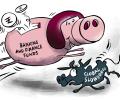
Even as banks and finance companies are reporting record-high earnings, their weighting in the benchmark National Stock Exchange Nifty50 Index has seen a downward trajectory. Investors expect a stronger performance from other sectors in the new year. Currently, banking, financial services and insurance (BFSI) companies collectively hold a weighting of 34.5 per cent, down from 36.7 per cent at the end of December 2022 and a record high of 40.6 per cent at the end of December 2019. This represents the sector's lowest weighting in the index since December 2021 when it stood at 33.7 per cent.

IT services firm Tech Mahindra on Thursday posted a 57.6 per cent growth in consolidated net profit at Rs 718.4 crore (Rs 7.18 billion) for the second quarter ended September 30, aided by growth across verticals especially retail, travel and logistics and uptick in demand from Europe.

Among the Sensex firms, Kotak Mahindra Bank, Asian Paints, Tata Consultancy Services, HCL Technologies, Infosys, Tata Steel, Wipro, Bajaj Finance, Tata Motors, Titan and Bajaj Finserv were the major laggards. In contrast, IndusInd Bank, ITC, Bharti Airtel, Maruti, UltraTech Cement, Mahindra & Mahindra and State Bank of India were the gainers.

Domestic equity markets will be driven mainly by quarterly earnings, global trends, and the movement in crude oil prices in this holiday-shortened week, analysts said. Investors would also keep an eye on the Middle East amid the ongoing Hamas-Israel conflict and the trading activity of foreign investors. Markets will remain closed on Tuesday for Dussehra.

Tata Group remained India's largest business conglomerate in market capitalisation in calendar year 2023 while the Mukesh Ambani camp raced ahead of the Adani businesses to become the second-largest. The Tata companies ended 2023 with a combined group market capitalisation of Rs 28.68 trillion, up 35 per cent from the Rs 21.2 trillion at the end of December 2022. Ambani's group mcap is Rs 19.42 trillion at the end of CY23, up 10.7 per cent from the Rs 17.6 trillion a year ago.

Passenger vehicle sales in India touched a record high of 41.08 lakh units in 2023, growing by 8.3 per cent over the previous year driven by SUVs, which accounted for almost half of the total dispatches from manufacturers to dealers. The record sales have been achieved despite an increase in the average price of vehicles to Rs 11.5 lakh last year as compared to Rs 10.58 lakh in 2022. Market leader Maruti Suzuki, Hyundai Motor India, Tata Motors and Toyota Kirloskar Motor reported their best-ever annual sales in 2023.

Re-rating of Axis Bank's stock may continue in the near-future, believe analysts, as the risk-reward on the stock remains favourable amid healthy financials. The bullish stance comes after the Mumbai-based lender delivered a strong outperformance in the March quarter of fiscal year 2023-24 (Q4FY24) on core pre-provision profit and net profit, with improving asset quality. Axis Bank's net interest margin (NIM) expanded, against expectations, even in a tough market.

Investors should view any bounce-back in bank stocks as an opportunity to exit the pack, analysts suggested, as the worst may not be over yet. The recent quarterly results of HDFC Bank and Axis Bank disappointed the Street, triggering a marketwide selloff by foreign institutional investors, especially in banking counters. While HDFC Bank, which was the anchor for the market correction during the past week, ended 2 per cent higher amid short covering on Wednesday, Axis Bank's shares settled 3 per cent lower.

Among the Sensex firms, ITC, Kotak Mahindra Bank, ICICI Bank, Nestle, Axis Bank, IndusInd Bank, UltraTech Cement, Bajaj Finance, Maruti and HDFC Bank were the major laggards.

From the Sensex basket, Tata Motors, State Bank of India, Tata Steel, Power Grid, NTPC, Bajaj Finserv, Bajaj Finance and Asian Paints were the major laggards.
Don't count too much on the anchor investor quota, as it will provide stability to the stock for only a short period

India has been a tea sipping society. But the aromatic wave of coffee culture is wafting across it.
Benchmark indices fell on Monday with the BSE Sensex declining 306 points, mainly dragged down by Reliance Industries. Foreign funds outflow also added to the overall bearish trend in equities on Monday. The 30-share BSE benchmark fell 306.01 points or 0.55 per cent to settle at 55,766.22. During the day, it declined 535.15 points or 0.95 per cent to 55,537.08. The broader NSE Nifty dipped 88.45 points or 0.53 per cent to 16,631.

The Reserve Bank of India's (RBI's) latest order on unsecured loans is set to hit the banking sector's growth in the near-term, cautioned analysts, as they see banks slowing down on aggressive retail lending. Besides, cost of funds for non-banking finance companies (NBFC) is expected to inch up as banks will pass on higher capital charge to NBFCs. "We believe the fallout of the RBI action will be mainly on growth, given the rising dependence on unsecured retail loans and lending to NBFCs for growth.

Maruti recorded a 13.12% year-on-year surge in average revenue earned per car in 2023 compared to M&M's 7.56%, Hyundai's 6.76% and Tata Motors' 1.88%.

The previous May peak was observed in 2018 when the domestic PV wholesales stood at 301,238 units.
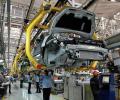
The K-shaped economic recovery in India from the pandemic slowdown shows in corporate results as well. The automobile sector, which represents big-ticket consumption, continues to do well and has increased its share in corporate revenues and profits while fast-moving consumer goods (FMCG) companies that sell low-ticket consumer goods are struggling with poor sales and earnings growth. The share of the automobile sector, including makers of auto ancillaries, in corporate net sales rose to a 10-quarter high of 10.05 per cent during July-September 2023 (Q2FY24) from 8.94 per cent a year earlier and 9.75 per cent in Q1FY24.

Domestic macroeconomic data announcements, global trends, quarterly earnings and foreign fund trading activity would dictate terms in the equity markets this week, analysts said. Besides, movement of rupee against the US dollar and global oil benchmark Brent crude price would also guide the trading pattern in the equity markets. "From a macroeconomic perspective, market participants will be closely observing key events like the upcoming release of the US manufacturing PMI data, US services PMI data and US non-farm payrolls scheduled between August 1 and August 4.

April-June 2023 (Q1FY24) was a mixed quarter for India's top family-owned business groups. Three of the big five in terms of revenue reported a year-on-year (Y-o-Y) decline in combined net sales and two saw a Y-o-Y fall in net profits. Combined net sales of all listed companies in the five groups were up just 2.2 per cent Y-o-Y at Rs 6.6 trillion in the quarter, down sharply from the 10.3 per cent in the March 2023 quarter (Q4FY23) and 42.8 per cent in Q1FY23.

Operating margins have been the primary driver of corporate earnings in India in recent quarters, despite revenue growth suffering from weak consumer demand. Companies across sectors have reported a sharp improvement in earnings before interest, tax, depreciation, and amortisation (Ebitda) margins over the past two years, benefiting from lower commodity and energy prices. Higher margins more than compensated for slower revenue growth, resulting in double-digit growth in net profit for five consecutive quarters.

'Today's engineering graduates have to learn the skills to solve problems which is actually a higher order skill.'
